Being a sound healing practitioner is not simply about collecting certifications, accumulating knowledge, mastering different techniques, or learning to play a wide range of instruments. I know this because I was, and still am one of those eternal students.
Over the last 10 years, throughout my journey with sound healing and complementary therapies, I have studied with some great teachers, attended different sound healing schools, and explored different approaches to working with sound.I have been drawn to both Western approaches, which often focus on areas such as the nervous system and regulation, and Eastern approaches, which place greater emphasis on energy and the subtler aspects of our experience.
I am always curious to learn more, question what I already know, and dive deeper into the possibilities of sound and its application in therapeutic settings. And I believe this continuous learning is important.
Technical and theoretical knowledge matter. Understanding sound and physics, the nervous system and our physiology, different therapeutic principles, the sound healing instruments we work with, and the appropriate use of different techniques gives us an important foundation for our work.
However, over the years, I have also come to realise something equally important. Technical skill, theoretical knowledge, and even thousands of hours of sound healing practice are not enough on their own.
Without presence, stillness, mindfulness, compassion, and an ongoing commitment to our own inner inquiry and self-development, even highly developed technical skills can ultimately become just playing sounds.
Before going further, I want to make one thing clear: what I share in this article is my personal perspective, shaped by my own experience, training, teachers and years of working with sound.
I don’t present it as the way sound healing should be practised, nor as a universal truth. There are many different traditions, approaches and perspectives within sound healing, and I continue to learn from many of them.
This is simply how I have come to understand the role of the practitioner and the importance of inner work throughout my own journey.
The practitioner is part of the experience
When someone comes to a sound bath or a 1:1 sound healing session, they are not simply experiencing sounds. They are experiencing the practitioner as well.
They are entering a space created not only through sound, but through our presence, our attention, our communication, our ability to truly listen and be there for the other, and the way we respond to what is happening in front of us.
For me, the role of a sound healing practitioner is first and foremost to create a safe and welcoming space where the recipient can feel accepted and free to be themselves. A space where they don’t need to wear a mask or to hold back. A space where they don’t need to perform. That’s why acceptance is key to creating a safe space for the other.
When a person feels accepted and sufficiently safe, they can begin to relax, open up and engage more deeply with the process. This is why the practitioner’s own inner work becomes so important.
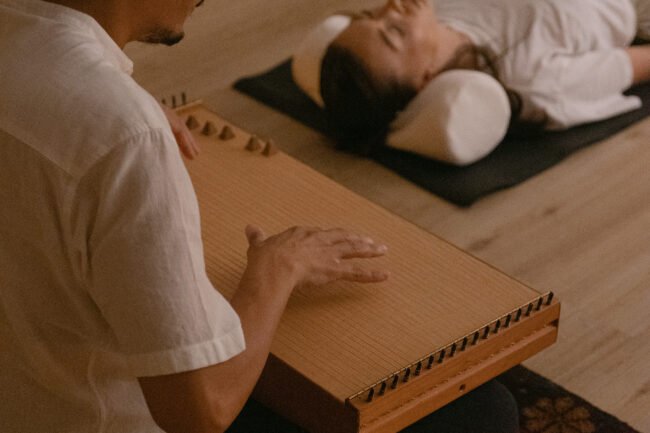
Learning to be present
Developing a strong foundation of mindfulness and loving awareness allows us to become more familiar with our own nature. It teaches us to notice our thoughts, emotions, reactions, expectations and judgments without immediately being driven by them.
It also teaches us something that is particularly important for a sound healing practitioner: how to stay present in silence.
One of the first people who taught me the importance of this was my teacher and friend, Elèna Melnishca. From the very beginning, she emphasised the importance of leaving a long space of silence at the end of a session.
In my first years of practising, I found that silence uncomfortable. I would often feel the need to do something, to say something, or to bring the session to a clear conclusion. But as I continued to grow in my sound healing practice, my relationship with silence gradually changed.
I began to realise that this quiet space at the end of a session might be one of the most important moments of the whole therapeutic process. After the sounds slowly dissipate, something is still happening.
The body has a chance to settle. The mind has space to process. The experience can unfold without being interrupted or immediately interpreted. It becomes a moment of integration.
And sometimes, the most valuable thing we can do as practitioners is simply to remain present and allow that silence to be there. No explanation, no instruction, just presence. Not every moment needs to be filled with sounds, words or instructions.
Sometimes the most valuable thing we can offer is our ability to remain centred, attentive and comfortable with what is unfolding and the more deeply we understand ourselves, the more present we can be with the person in front of us. And this presence allows us to listen differently.
Instead of simply following a protocol because it is the next step in the sequence, we learn to observe, listen, sense and respond to what is actually happening in the moment.
Meditation and the practitioner’s inner work
My own meditation practice has played a huge role in this. I have participated in 10-day Vipassana retreats and have maintained a daily meditation practice for almost half of my life. Meditation has helped me become much more familiar with my own mind, my reactions and the patterns I carry, and to become more comfortable with silence and with whatever emerges within it. It has also transformed me as a person more than anything else I tried throughout my life.
I used to be a heavily anxious person and today, I genuinely enjoy the space between my thoughts.
Because I have experienced first-hand the transformative power of meditation, I always encourage my students to make space for meditation in their daily lives. I don’t see it as something separate from their sound healing practice. For me, it is as important for the peace of the mind as food is for the body.
Beyond protocols and techniques
Protocols and techniques are valuable. They give practitioners structure, confidence and a framework within which to work safely. But a protocol should never replace awareness.
Two people can attend the same sound healing session and have completely different experiences. Their needs, emotional states, expectations and responses may be very different.
A skilled practitioner needs to be able to recognise this. This doesn’t mean abandoning professional structure or improvising without knowledge. It means learning how to combine knowledge with awareness. For new practitioners, this can take time, and it is indeed part of the learning process.
Knowing what to do is one thing. Knowing when, how and why to do it — and when not to — requires another level of understanding and many hours of practice.
This is one of the reasons mindfulness and loving presence are central to the way I practice as well as teach sound healing. They are not additional concepts added to the curriculum. They are part of the foundation.
But how do we actually continue growing as sound healing practitioners?
There are many ways to deepen our practice: through meditation, further education, understanding the science and physics of sound, developing greater familiarity with our instruments, receiving honest feedback, working alongside experienced practitioners, and continuing to explore different approaches.
I have explored these practical aspects in more detail in How to Grow as a Sound Healer: A Complete Guide for Practitioners.
The importance of the practitioner’s own inner work
I don’t believe that a practitioner needs to have everything figured out or have resolved all of their own challenges before they can support another person. We are all human and first and foremost, we need to learn to accept ourselves in the same way that we encourage others to accept themselves.
We all have our own experiences, limitations, patterns and areas where we continue to grow. But we do have a responsibility to become increasingly aware of ourselves.
Our unresolved emotions, our need for validation, our desire to be seen as an expert, our assumptions about what another person “should” experience — all of these can unconsciously enter the therapeutic space if we don’t pay attention.
This is why personal practice matters.
Meditation matters.
Self-reflection matters.
Supervision matters.
And perhaps most importantly, humility and honesty matter.
When we hold space for another person, it is not about us demonstrating how much we know, how many techniques we have mastered, or how skilled we are with our instruments.
It is about the person in front of us.
Our role is not to impress them, fix them, or make the session about ourselves. It is to meet them where they are, listen, remain present, and create the space they need. This requires humility. We don’t need to pretend to be someone else and we certainly don’t need to pretend that we have all the answers.
We need to be transparent about what we know, what we don’t know, what we can offer and where our professional boundaries lie. This is not a weakness but it is part of becoming a mature practitioner.
The instruments are important but so are we
The instruments are important.
The techniques are important.
The knowledge is important.
The experience is important.
But who we are when we hold space for another person may be even more important.
A singing bowl doesn’t create compassion.
A tuning fork doesn’t create presence.
A certificate doesn’t create wisdom.
These are qualities that we cultivate within ourselves through practice, self-awareness and a willingness to keep learning.
This is why I don’t see sound healing training simply as learning how to use instruments. It is also an invitation to develop the practitioner who is holding those instruments. To become a better listener. To become more comfortable with silence. To recognise our own reactions and to remain curious rather than judgmental. And most importantly, to meet another person where they are, rather than where we think they should be.
Sound healing is also about who we are
After years of working with sound and continuing to study, I still consider myself a student. There is always more to learn about sound, the human experience, therapeutic practice and, perhaps most importantly, ourselves.
For me, this is what makes sound healing such a profound path of practice. It is not only about the sounds we create. It is also about the presence from which we create them.