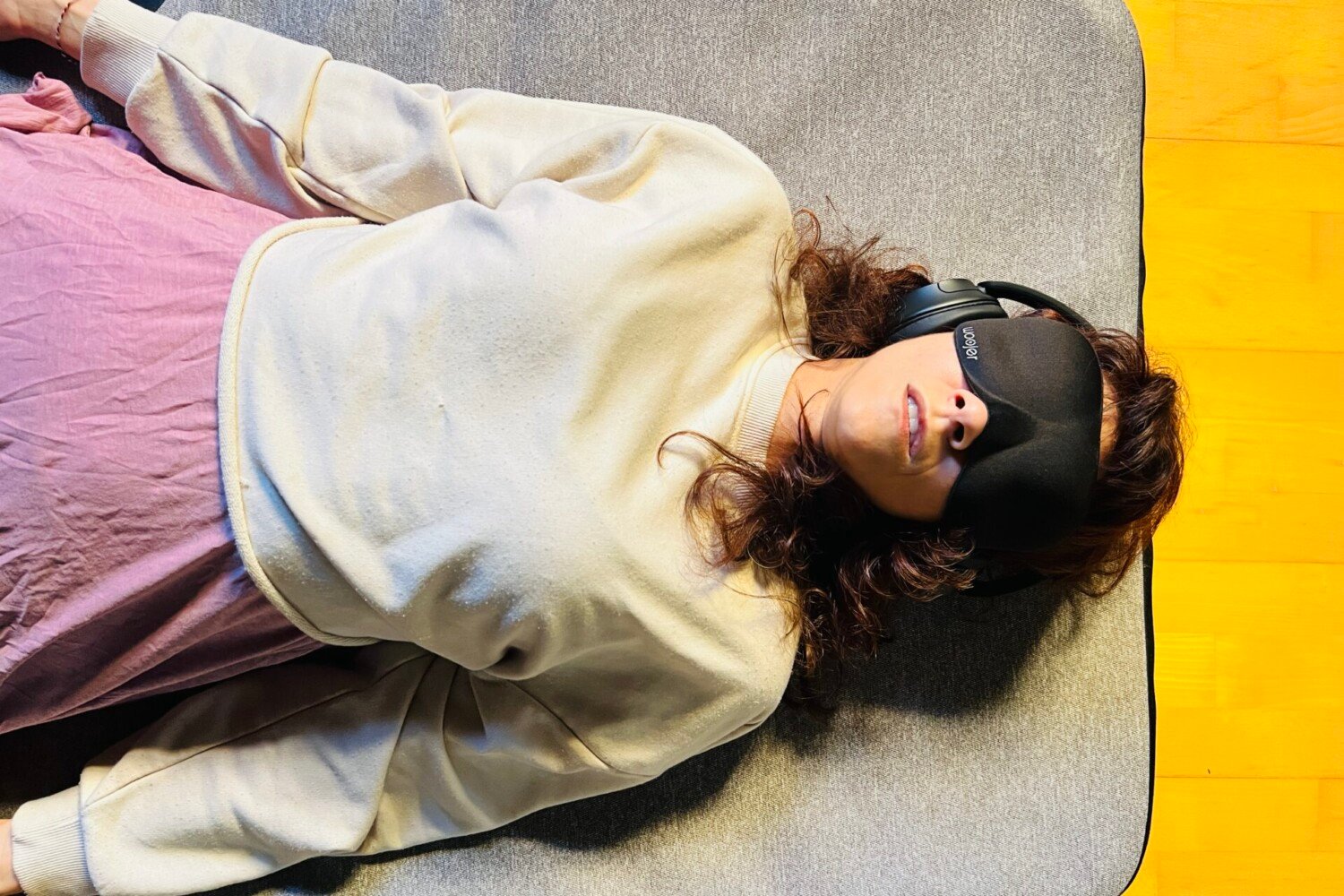
As a sound therapist, I am always interested in exploring new ways of working with sound and vibration. I recently purchased the Woojer Vibroacoustic Mat because I wanted to explore how I could incorporate vibroacoustic therapy into my professional sound healing sessions.
After spending time experimenting with it, first with friends and family and then with clients, I wanted to share my experience so far — what I like about it, how I use it, and why I think it can be an interesting addition not only to a sound healing practice, but also for anyone who would like to explore vibroacoustic experiences at home without investing in a large, permanent system.
Disclosure: I purchased the Woojer Vibroacoustic Mat myself. I am also a Woojer affiliate, which means I may receive a commission if you purchase through my affiliate link. This does not affect my review, which reflects my own experience with the product.
The Woojer Mat: Quality and Design
The first thing I noticed was the attention to detail. The packaging, the brochures and the mat itself all give a very good first impression.
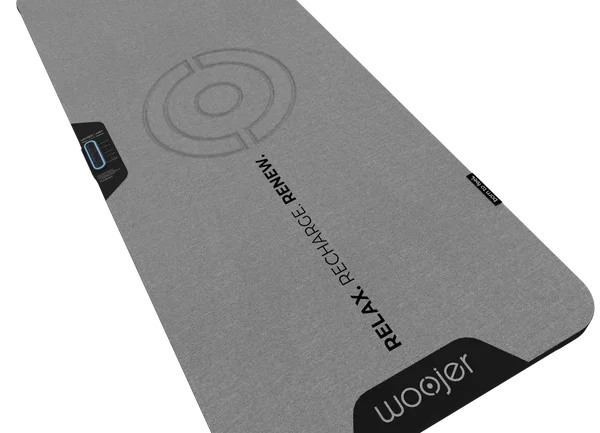
The mat is made from durable, breathable Airmesh and soft-touch fabric, with thin internal padding and six embedded haptic transducers. It feels well made, the design is sleek and minimal, and it is comfortable to lie on, particularly when placed on top of a mattress or a treatment surface such as a massage bed.
The controls are also very straightforward. You can adjust both the volume and the intensity of the vibration using the control panel on the side of the mat, making it easy to find the level that feels right for you or your client.
And the vibration can be adjusted from very light to surprisingly powerful. At higher intensity, the sensation can feel almost like a deep-tissue massage or being in a jacuzzi. At lower levels, it becomes much more subtle and relaxing.
I have found this particularly interesting when using it alongside sound because the client is not only listening to the sound but also physically experiencing the vibration through the body. We have sensory receptors in the skin that allow us to perceive vibration, and the Woojer Mat allows low-frequency vibrations to be distributed across different areas of the body. In my experience, this can contribute to a deeply relaxing experience and a sense of physical release.
One Thing to Be Aware Of
There is one practical point worth mentioning. After around 40–50 minutes of continuous use, I have noticed that the control panel can become quite warm. This is something I think is worth mentioning, particularly if you are considering using the mat professionally for longer sessions.
Woojer states that a typical MAT session lasts around 30 minutes and that the device has an automatic shut-off after approximately one hour for safety.
In my own experience, I have occasionally experienced the mat switching off before reaching the one-hour mark. So, if you are planning to use it for longer professional sessions, this is something to keep in mind.
I would recommend following the manufacturer’s instructions and allowing the mat to cool if it becomes excessively warm. Woojer’s manual specifically advises discontinuing use and contacting their support team if the MAT becomes excessively warm.
Using the Woojer Apps
There are two mobiles app you can download and use free of charge and allow you to control and use the mat.
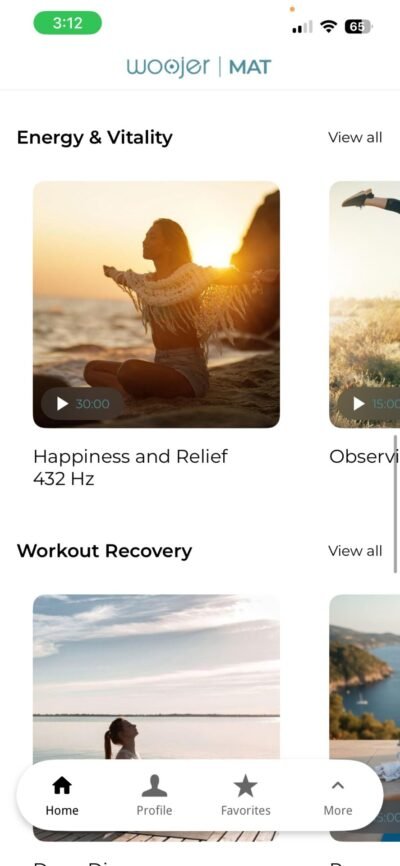
The Woojer app can be used with various Woojer products, including the Vest, Strap and Mat, and allows you to adjust settings such as volume and vibration directly from your phone. There is also a Woojer Mat app with a selection of recordings created specifically for use with the mat, including shorter 15-minute and longer 30-minute experiences.
This makes it easy to choose a recording and start exploring the experience without having to create your own setup.
The selections cover areas such as stress and mindfulness, back and muscle relief, period comfort, restorative sleep, enjoyment and vitality, and workout recovery.
I have found several recordings that have a powerful effect on me and on the people I have tested them with, although I can’t say that all of the recordings produce the same result. Some work much better for me than others.
One nice feature of the app is that you can save your favourite recordings, making it easy to find the ones you enjoy and want to use regularly.
But for me, one of the most interesting features is that you are not limited to the recordings provided by Woojer.
The Woojer Mat App
Choosing the Right Headphones
If you are going to use the mat with music or sound recordings, I think it is worth investing in a good-quality pair of headphones.
I personally use a high-quality pair of Bluetooth headphones with active noise cancellation. This allows the listener to hear the recording clearly while simultaneously experiencing the physical vibration from the mat.
You can also use traditional wired headphones, so you don’t necessarily need Bluetooth. The important thing, in my opinion, is to use comfortable headphones that provide a good-quality and immersive listening experience, particularly when working with detailed sound healing recordings.
The combination of good headphones and the physical vibration of the mat creates a very different experience from simply listening to the same recording through ordinary speakers.
Using Your Own Music and Sound Healing Recordings
You can use practically any audio source from your phone, including platforms such as YouTube, Spotify and SoundCloud, as well as your own recordings.
The mat responds to the audio signal and translates it into vibration that can be experienced directly through the body, alongside the auditory experience of listening to the sound.
This is particularly useful for my work because I already have a large collection of my own recordings using different sound healing instruments, from Himalayan singing bowls to gongs and crystal singing bowls.
Therefore, I mostly use some of my own recordings, as well as high-quality recordings from well-known sound healing and therapeutic music producers such as Dr. Jeffrey Thompson and John Goldman.
Being able to experiment with different recordings and observe how the body responds to the resulting vibration is one of the aspects of the mat that I find most interesting.
Using the Woojer Mat for Vibroacoustic Therapy
My main reason for purchasing the Woojer Mat was to explore vibroacoustic therapy as an additional element of my sound healing sessions.
Sound healing is inherently vibrational. When we work with instruments such as Himalayan singing bowls, gongs and crystal singing bowls, we are already experiencing sound not only through hearing but also through the physical sensation of vibration. Vibroacoustic therapy offers another way of exploring this vibrational dimension, using transducers to deliver the vibration directly through the body.
The Woojer Mat has multiple transducers distributed throughout its surface, so the vibration can be experienced across different areas of the body rather than coming from a single point. When combined with appropriate sound recordings, I find the experience deeply relaxing and immersive.
I particularly enjoy experimenting with different intensities and recordings rather than simply turning the vibration up as high as possible. Sometimes a subtle vibration underneath a piece of music creates a much more interesting experience than a very strong one.
For me, the mat is not replacing the instruments and techniques I already use in sound therapy. Singing bowls, gongs and other acoustic instruments already create a rich experience of sound and vibration. I see the Woojer Mat as another tool that can complement these approaches, offering a different and more controlled way of delivering vibration across the body.
A Vibroacoustic Setup You Can Take Almost Anywhere
Another thing I really appreciate is the portability.
The Woojer mat can be folded and moved easily. It comes with a carrying bag, and this makes a big difference if, like me, you don’t always work in the same location.
I can take it to a client’s home, a retreat, a wellness event or another treatment space without needing to transport a large piece of equipment.
It can be placed on different surfaces, including a mattress or a chair. Woojer does not recommend using it directly on the floor, so I follow the manufacturer’s recommendations when setting it up.
For a practitioner who travels between locations, I think this is one of the mat’s biggest advantages.
However, I should point out that the dimensions are quite large. It is easy enough to take with you in a car, but it would be quite challenging to take on a flight. The Woojer Mat measures 75 × 30 × 1.7 inches (approximately 190.5 × 76.2 × 4.3 cm).
So while it is portable compared with a dedicated vibroacoustic bed, it is not exactly something you can casually put in your hand luggage!
It essentially gives you a portable vibroacoustic setup without having to dedicate a permanent space to it.
What I Like Most About It
After using the mat for a couple of months, there are a few things that stand out for me.
The physical sensation
The vibration can be remarkably powerful and, at the right intensity, can create a sensation that reminds me of a deep-tissue massage.
The versatility
I can use my own recordings, music from different platforms, or the recordings available through the Woojer ecosystem.
The portability
It’s light weight and easy to take with me wherever I am working — especially by car.
The combination of sound and vibration
For me, this is ultimately the most interesting part. It creates another way of experiencing sound — not only through listening, but through a more continuous and distributed sensation of vibration across the body.
My Overall Experience
Overall, I am very happy that I decided to explore the Woojer Mat.
I bought it because I wanted to find a practical way to introduce vibroacoustic therapy into my sound healing work, and I think it has a lot of potential in that context.
It is well designed, comfortable, powerful and, most importantly for me, flexible enough to work with the sounds and recordings I already use.
I am still experimenting with different recordings, vibration intensities and ways of incorporating it into my offerings. As I mentioned earlier, I don’t see the mat as a replacement for the singing bowls, gongs or other acoustic instruments. Rather, I see it as another layer that can be added to my sound healing services. And that is probably what I find most exciting about it: the possibility of combining the emotional and auditory experience of sound with a very tangible physical sensation.
At the same time, I think it is important to be realistic about what you are buying. Not every recording available through the app has the same effect, the control panel can become quite warm during extended use, and the size of the mat is something to consider if you travel frequently by plane.
For me, however, these are relatively minor considerations compared with the flexibility and possibilities it offers.
For anyone interested in exploring vibroacoustic therapy whether for personal relaxation or as an additional tool within a professional wellness or sound healing practice I think the Woojer Mat is definitely worth exploring.
10% Off the Woojer Mat
If, after reading about my experience, you would like to explore the Woojer Mat yourself, you can use my discount code: MANOLIS
The code can be used to get 10% off the Woojer Mat and other Woojer products.
You can also purchase through this affiliate link. If you do, I may receive a commission at no additional cost to you.
I always prefer to share products that I have personally used and genuinely find interesting for my work. I hope this review has given you a better idea of what the Woojer Mat actually feels like, what I like about it, and how I am exploring its use within my sound healing practice.